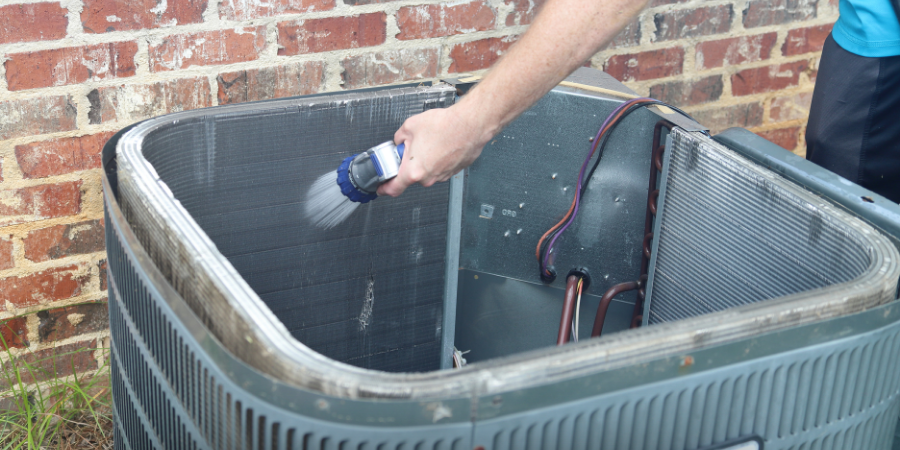
If your AC coil looks dirty, you might be tempted to grab the hose and rinse it off. Sometimes that’s a reasonable place to start, but we recommend following a few additional steps first. Knowing how to clean AC coils starts with identifying which coil you’re dealing with and what your equipment’s manufacturer allows.
Which AC Coil Are You Cleaning?
The average central air conditioner has two coils:
- The outdoor condenser coil releases heat collected inside your home. Dirt, leaves, and grass clippings can collect on its surfaces and restrict airflow.
- The indoor evaporator coil absorbs heat from indoor air. It sits inside the air handler or near the furnace, where dust can accumulate if filtration is poor.
Both coils need clean surfaces to transfer heat effectively. Cleaning the outdoor unit will not remove buildup on the indoor coil.
How to Clean Outdoor AC Condenser Coils
These steps apply to basic exterior cleaning of an accessible outdoor coil. Check your equipment manual first. Coil designs and approved cleaning methods vary.
1. Shut Off Power
Turn the thermostat off, then disconnect power using the equipment’s designated disconnect or breaker according to the manufacturer’s instructions. Turning the thermostat off alone does not isolate electrical power.
If you can’t confidently identify the correct power shutoff, leave the cleaning to a technician. Do not open electrical compartments.
2. Clear the Area Around the Unit
Remove loose leaves, twigs, and grass clippings around the cabinet. Wear gloves and keep your hands away from sharp fins.
Pay attention to the space between the unit and the house (debris can collect where it is harder to see). Trim nearby vegetation to the clearance specified by the equipment manufacturer, and direct mower discharge away from the unit.
3. Gently Rinse Accessible Coil Surfaces
If the manufacturer permits it, use a garden hose with a gentle stream to rinse accessible outdoor coil surfaces. Keep water away from electrical compartments and connections.
Do not use a pressure washer or a concentrated jet. The thin fins can bend, restricting the airflow you are trying to restore.
Leave cabinet panels, protective guards, and the fan assembly in place. If they prevent access to the dirty area, schedule professional AC maintenance rather than taking the unit apart.
4. Skip Unapproved Cleaners
Water may be enough for loose surface dirt. Stubborn buildup needs a cleaning method approved for that particular coil.
Do not assume a bottle labeled “coil cleaner” is compatible with every system. Coil material, coatings, dilution, contact time, and rinsing requirements all affect the choice. Avoid household cleaners and aggressive scrubbing.
5. Follow the Restart Instructions
Allow the equipment to drain and dry as directed by the manufacturer before restoring power. Put the hose and tools away, then restart the system according to its instructions.
If cooling remains poor, repeated washing is not the next step. An AC repair inspection can identify problems that cleaning cannot fix.
How Are Indoor Evaporator Coils Cleaned?
We recommend professional cleaning for indoor evaporator coils. Access can involve working around wiring, insulation, delicate fins, and the condensate system.
A technician will inspect the coil, select an approved cleaning method, and protect surrounding components. Depending on access and buildup, cleaning may involve removing surface debris and applying a compatible cleaner. Any required rinsing must be controlled so water and loosened dirt do not overflow the drain pan.
The drain deserves attention during this work. Washing debris into a restricted drain can create another problem. Our guide to why air conditioners leak water explains how drainage issues and frozen coils can lead to indoor leaks.
How Often Should AC Coils Be Cleaned?
You should have coils inspected during annual maintenance and cleaned when their condition calls for it. The U.S. Department of Energy recommends checking the evaporator coil every year and cleaning it as needed.
For Houston homeowners, a useful habit is checking the outdoor unit after mowing, landscaping work, or nearby construction. Visible buildup may need attention before the next scheduled visit. Indoor cleaning frequency depends more on filtration, equipment condition, and the inspection findings.
Coil inspection is one part of a maintenance visit. Our article on what HVAC maintenance includes explains the other checks involved.
Can Dirty Coils Cause Cooling Problems?
Yes, buildup can interfere with airflow and heat transfer, reducing cooling performance and increasing runtime. A heavily restricted indoor coil can also contribute to freezing.
Those symptoms do not prove the coil is dirty though. A clogged filter, blower problem, or refrigerant issue can produce similar complaints. If you see ice, turn cooling off and arrange an inspection. Do not chip it away or try to clean a frozen coil.
Let Cold Air Pros Handle Your Next AC Tune-Up
You shouldn’t have to spend your weekend taking an air conditioner. Clear away yard debris, follow your equipment’s care instructions, and let us handle the cleaning that requires opening the system!
At Cold Air Pros, we help Houston homeowners maintain and repair their cooling equipment. Our HVAC maintenance plans make it easier to stay on schedule with routine service, and we provide new AC installation when it’s time to replace old equipment. Contact our team or call (713) 476-0429 to schedule service.

